| Tethering -- a new leash on life |
Over the years, I've become a huge advocate of tethering. My first introduction to the idea came
from Pat Miller's excellent article in Whole Dog Journal "Tethered to Success" -- this article can be
found in her wonderful book "Positive Perspectives."
from Pat Miller's excellent article in Whole Dog Journal "Tethered to Success" -- this article can be
found in her wonderful book "Positive Perspectives."
When I suggest tethering to my clients, they frequently give me a blank look and ask me what
"tethered" means. It's become such an important part of my own lifestyle, I have to stop and think
about explaining it. So here are pictures and descriptions. Beagie has volunteered to show how
tethering works in her life. Fred makes a cameo appearance as well.
"tethered" means. It's become such an important part of my own lifestyle, I have to stop and think
about explaining it. So here are pictures and descriptions. Beagie has volunteered to show how
tethering works in her life. Fred makes a cameo appearance as well.
What's a Tether? A tether can be any type of line attached to the dog on one end and an immovable
object on the other end. I have used leashes, lengths of string on small dogs and puppies (string
seems to be really difficult to chew through--they can't get a proper hold on it to saw through), and a
coated cable from Home Depot that was cut to a specific length. I have used combinations of all of
the above to get the exact amount of freedom that a particular dog can handle.
object on the other end. I have used leashes, lengths of string on small dogs and puppies (string
seems to be really difficult to chew through--they can't get a proper hold on it to saw through), and a
coated cable from Home Depot that was cut to a specific length. I have used combinations of all of
the above to get the exact amount of freedom that a particular dog can handle.
Here's Fred on a 4 foot tether (coated cable) attached to my carport.
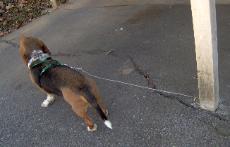
Fred is wearing a Sure-fit harness by Premier. (Beagie
wears one, too.) This takes the pressure off of his neck.
I love these harnesses for everyday-wear in the house and
around the yard. They're easy to put on and the dogs are
very comfortable in them.
wears one, too.) This takes the pressure off of his neck.
I love these harnesses for everyday-wear in the house and
around the yard. They're easy to put on and the dogs are
very comfortable in them.
When to tether? First, ONLY when you are present. Never tether your dog, if you are not going
to be around. If your dog needs to have limited access to the world in your absence, use a crate.
Once you've got that under control, tether your dog whenever he's in a situation where the
temptations of life are just too much for good behavior.
to be around. If your dog needs to have limited access to the world in your absence, use a crate.
Once you've got that under control, tether your dog whenever he's in a situation where the
temptations of life are just too much for good behavior.
Fred is tethered when people come over for classes or lessons. Early on, when we were working
on "don't bark at me when I'm carrying on a conversation with someone else" he was tethered so
that I could concentrate on my movements in the training process and limit his access to other
temptations. ("Okay, I won't bark at you, I'll just run out in the street and roll in that dead
squirrel.")
on "don't bark at me when I'm carrying on a conversation with someone else" he was tethered so
that I could concentrate on my movements in the training process and limit his access to other
temptations. ("Okay, I won't bark at you, I'll just run out in the street and roll in that dead
squirrel.")
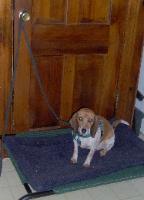
And then there's Beagie. I'm pretty sure that dear little Beagie
had never been an indoor dog until she came to our house. With
her initial incidents of resource guarding, it was imperative that
I greatly limit her access to the house, so that Fred and Callie
could move about as they pleased.
had never been an indoor dog until she came to our house. With
her initial incidents of resource guarding, it was imperative that
I greatly limit her access to the house, so that Fred and Callie
could move about as they pleased.
Well-behaved creatures get all the access they can stand, and
those that can't behave, don't get more access then they can
handle.
those that can't behave, don't get more access then they can
handle.
We're still working with Beagie. At first, her tether was about 2 feet. She now spends most of
her time in the kitchen on a 15 foot tether. (We spend most of our time in the kitchen, too -- it's a
big roomy place.) She is not 100% house trained--the cold weather really sent us back this winter.
I have begun to allow her to wander a little bit in other areas of the house with either the tether
off the hook (then it serves as a drag line...something I can step on in case of emergency) or just
leave her off tether for a bit altogether.
We have not had any aggressive incidents from her since August 2005, nor has she "levitated" onto
the kitchen counter, kitchen table, or top of washing machine (where the cat food is) since late Fall
2005. Because she has become such a good citizen, she has earned a little more freedom.
When she has access to other parts of the house, it clearly overstimulates her. She goes on
"vibrate" after about 15 minutes, and I'll put her in her crate (which has a calming effect on her).
This has been her pattern from the start. When moving from the 2 foot tether, to a 4 foot
tether...she could only stand that extra 2 feet of freedom for 10 to 15 minutes at a time. I
increased the frequency of the 10-15 minute periods throughout the day. And now she spends most
of the day with 15 whole feet of freedom. I am increasing her access to other parts of the house
the same way--with more frequent intervals of "10 minutes of freedom."
A little too long of a tether and Beagie starts "washing" a
skillet. The ultimate solution here will be to rearrange
my pots and pans.
skillet. The ultimate solution here will be to rearrange
my pots and pans.
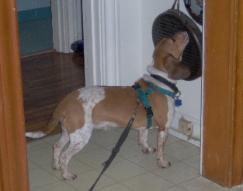
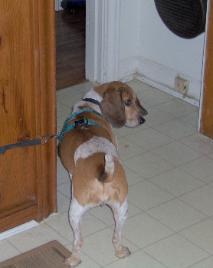
But for right now, when she does this I say
"oops! Do we need your short tether?" And
then shorten her tether so that temptation
is just out of reach.
"oops! Do we need your short tether?" And
then shorten her tether so that temptation
is just out of reach.
For those that say "Fifteen feet of freedom isn't much!" I have to agree. But it's about all Beagie
can handle at the moment. If she gets more than she can handle, we will undoubtedly see a
resurgence in resource-guarding, house soiling, and inappropriate access to the furniture (there is
the dining room table, you know).
I have to remind myself that Beagie was a little stray who came to me utterly terrified of doors
and all sorts of things related to the great indoors. It's quite likely that until coming to our home,
she had always been an outside dog. She certainly had no previous training. If it takes me a good
year or so to acclimate her to a life of civilized luxury, I think it's worth the investment of time for
both of us. I fully expect Beagie to be in my life for a good ten years more.
You can order ready-made tethers here: www.pettethers.com Order several different lengths!
can handle at the moment. If she gets more than she can handle, we will undoubtedly see a
resurgence in resource-guarding, house soiling, and inappropriate access to the furniture (there is
the dining room table, you know).
I have to remind myself that Beagie was a little stray who came to me utterly terrified of doors
and all sorts of things related to the great indoors. It's quite likely that until coming to our home,
she had always been an outside dog. She certainly had no previous training. If it takes me a good
year or so to acclimate her to a life of civilized luxury, I think it's worth the investment of time for
both of us. I fully expect Beagie to be in my life for a good ten years more.
You can order ready-made tethers here: www.pettethers.com Order several different lengths!
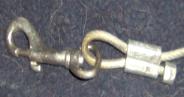
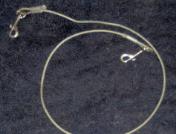
| Here's how to make a coated cable tether of your own...at any length. 1. Figure out how long you want the cable to be, and add 6 inches. (a 4 foot tether needs 4.5 feet) 2. Go to your local home store and have a clerk cut a 1/8" or 1/4" (depending on what's available) coated-cable to the length determined above. 3. Buy ferrules slightly larger than the cables (the clerk can help you with this) and two small but sturdy clips. 4. Run the cable through one side of a ferrule, then through the ring of the clip, then back down through the other side of the ferrule. Feel free to use the little "safety" cap that comes with the ferrules--it'll cover the rough edge of the cable. 5. Use a hammer to crimp the ferrule into place. You can buy an expensive crimping tool, but an old-fashioned hammer works pretty darned well. 6. Repeat steps 4 and 5 for the other end of the cable. |
Thoughts & Musings
 | |  | |  | |  | |  |
| | | | | | | | |
| The Happy Hound Havin' Fun with Tricks & Good Manners Peg Dawson Harrington, Trainer & Behavior Consultant Member, Association Pet Dog Trainers #63215 12/08 Member, International Association of Dog Behavior Consultants AKC CGC Evaluator #27443 615-584-2940 Copyright © 2008 Peg Dawson Harrington All rights reserved. |